
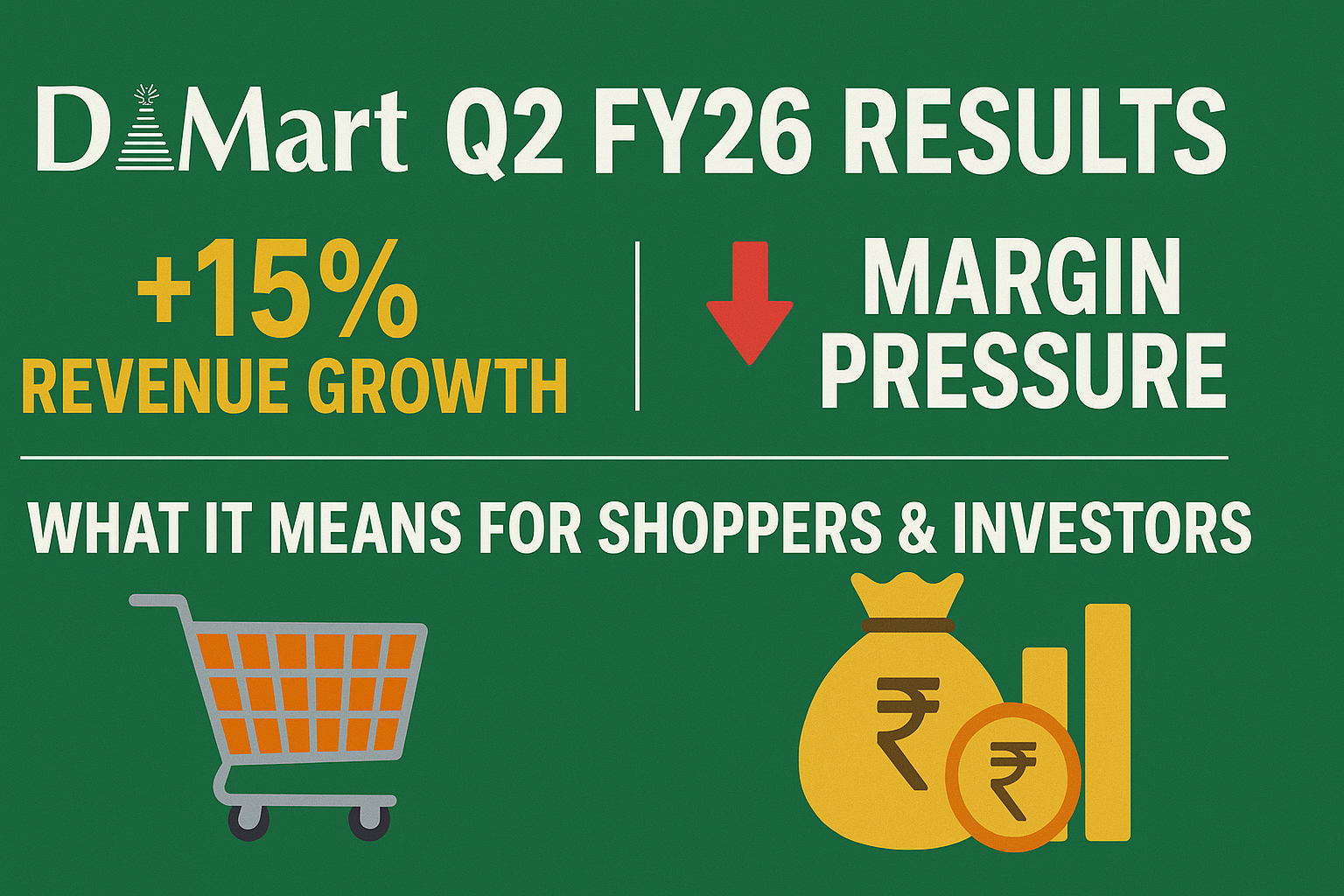
Quick summary: Avenue Supermarts (DMart) reported ~15–15.5% year-on-year revenue growth in Q2 FY26 while profit growth was muted and margins came under pressure. Older stores showed signs of revival, management passed GST benefits to customers, and the market reacted with a modest stock dip as analysts flagged rising operating costs and a softer sales mix. The Economic Times+2The Economic Times+2
1. Financial highlights (Q2 FY26 — key numbers)
| Metric | Reported (Q2 FY26) | YoY change / note |
|---|---|---|
| Revenue from operations | ₹16,218–16,676 crore (reported ranges across filings/news) | ≈ +15.4% YoY. Sources report ₹16,218.8–₹16,676 cr. The Economic Times+1 |
| Consolidated PAT | ~₹685 crore | +~4% YoY (muted vs. topline). The Economic Times |
| EBITDA / EBITDA margin | EBITDA growth lower than revenue; margin contraction flagged (EBITDA margin reported around ~7.5–7.6% by brokers) | Margin pressure due to cost mix, higher staff/operating costs. elitewealth.in+1 |
| Same-store (2+ years) growth | ~+6.8% | Older stores beginning to revive. mint |
| Stock market reaction | Shares fell low-single digits after results; broker commentary mixed | Market flagged margin concerns & online scaling costs. Moneycontrol |
(Notes: media sources report slightly different totals depending on standalone vs consolidated statements and rounding — numbers above reflect the consensus range reported in filings and press coverage.) alphastreet.com+1
2. What’s driving the 15% revenue growth?
- Store expansion — New store additions contributed materially to the topline; analysts expected strong contribution from new openings. The Economic Times
- Recovery in older stores — Two-year-plus stores grew ~6.8%, indicating traffic and basket recovery beyond expansion. mint
- GST pass-through — Management said DMart passed on GST cuts where applicable, supporting volumes/pricing competitiveness. mint
Takeaway for shoppers: More stores + competitive pricing means better access and possibly deeper value assortment in neighbourhoods where DMart expanded.
3. Why margins are under pressure
- Sales mix shift: Higher share of lower-margin categories (e.g., more food / perishables vs discretionary) compresses gross margins. Brokers flagged an “inferior sales mix.” Business Standard
- Rising operating costs: DMart is investing in staffing, store service levels, and scaling (including its online offering), which lifts operating expenses faster than gross profit. elitewealth.in
- Online costs & scaling: Analysts noted the online arm (DMart Ready/other digital initiatives) is being scaled back/reshaped but has incremental cost impacts that weigh on operating leverage. Moneycontrol
Investor angle: When topline grows but operating costs rise faster, margins compress — investors watch whether margin contraction is temporary (investment phase) or structural (worse mix, lower pricing power). Markets Mojo
4. Tables — Deeper look (comparative view)
A. Simple P&L snapshot (illustrative consolidated numbers compiled from filings & press)
| Item | Q2 FY25 | Q2 FY26 (reported) | YoY % |
|---|---|---|---|
| Revenue from operations | ₹14,444 crore | ₹16,676 crore (range reported ~₹16,219–16,676) | +15% |
| Total expenses | ₹13,575 crore | ~₹15,751 crore (reported ranges) | +16% |
| EBITDA | (implied) | grew less than revenue; margin down | — |
| PAT (consolidated) | ₹659–660 crore | ₹684–685 crore | +3.8–4% |
| Sources: company filings summarized in media reports. alphastreet.com+1 |
B. Margin drivers (qualitative table)
| Driver | Q2 FY26 impact | Why it matters |
|---|---|---|
| Sales mix (more FMCG/food) | ↓ Gross margin | Food/FMCG often lower margin vs apparel/electronics |
| Staff & store opex | ↑ Opex / ↓ EBITDA margin | Higher wages/service levels raise store operating costs |
| Online scaling/reshaping | ↑ Costs now, potential future reach | Short-term pain for long-term omnichannel reach |
| GST pass-through | ↓ Price but ↑ volume | Helps customers, but narrows per-unit margin if retailer absorbs cuts |
(Analysis and labels based on broker & media commentary.) Business Standard+1
5. What this means for shoppers
- Lower prices where GST cuts were passed on — Customers likely benefited on applicable SKUs as management stated they passed on benefits. mint
- More store choices and footprint growth — Expansion means improved availability and convenience in new micro-markets. The Economic Times
- Better service but possibly tighter assortment — Investments in staff/service may improve in-store experience; however, a focus on lower-margin staples could mean less promotional assortment on higher-margin discretionary goods.
Practical tip: If you shop for staples and grocery, DMart’s everyday low prices and GST pass-through likely help your monthly basket; for non-essentials, compare assortments with other retailers during sales.
6. What this means for investors
- Earnings quality watch: Revenue growth is healthy, but profit gains are muted — monitor if margin erosion reverses as store productivity improves and online costs normalize. alphastreet.com
- Catalysts to track next quarters: same-store sales rollforward, gross margin stabilization, operating expense trajectory, clarity on digital/online strategy and capex cadence. Markets Mojo
- Risk vs reward: If management can convert expansion into higher store productivity (lift SSSG) without permanent margin erosion, upside remains. If costs persist and mix keeps margins lower, multiple re-rating risk exists. Broker commentary immediately after results was mixed, reflected in a low-single digit stock drop. Moneycontrol+1
7. Management commentary & market reaction
- Management highlighted revival in two-year+ stores and passing on GST benefits to customers. mint
- Brokers (ICICI Securities, others) flagged EBITDA margin at ~7.6% being slightly below estimates and noted an “inferior sales mix” and elevated costs. The stock fell modestly on results as analysts digested the margin story. Business Standard+1
8. Outlook — what to watch next
- Same-store sales trajectory (will older stores sustain recovery?) mint
- Gross margin & category mix (does the mix normalize?) Business Standard
- Operating expense trend (are staffing/opex gains translating to better sales per store?) elitewealth.in
- Online strategy clarity (costs vs returns from DMart Ready or alternatives). Moneycontrol
9. Recommended calls to action (for content publishers)
- For shoppers: Publish a consumer-facing post highlighting GST pass-through SKUs, “how to save on your monthly basket at DMart” with before/after examples. (SEO: “DMart GST benefits October 2025”, “DMart staples prices Q4 2025”). mint
- For investors/readers: Produce an earnings-flash with a margin deep-dive and Q&A — link to the investor presentation and broker notes. (SEO: “DMart Q2 FY26 margin analysis”, “Avenue Supermarts Q2 FY26 investor takeaways”). alphastreet.com+1
10. Useful links & further reading
- Company investor relations / press releases (Avenue Supermarts). DMart
- Economic Times result summary. The Economic Times
- Moneycontrol coverage (numbers + analyst reaction). Moneycontrol
- Business Standard margin analysis. Business Standard
11. Internal interlinks (within this article)
- Financial highlights · Margin drivers · Shoppers impact · Investor implications · Outlook & watchlist
Bottom line
DMart’s Q2 FY26 shows that the company is growing the top line — driven by store additions and a revival in older stores — but profit growth is being capped by margin pressures from mix and rising costs. For shoppers, near-term benefits (GST pass-through, more stores) are tangible; for investors, the key question is whether margin headwinds are temporary investment season costs or signal a longer-term shift in profitability. The Economic Times+1
Are you planning to go grocery shopping and write on paper? why don’t you try Trupricer.com a digital shopping list creator Using trupricer mobile app, you can create a digital monthly shopping list in the app and there is no need to struggle with writing a list on paper every time
Andriod store link to download the app: https://play.google.com/store/apps/details?id=com.trupricer.user
IOS app store link :https://apps.apple.com/in/app/tru-pricer/id6480042106